Introduction
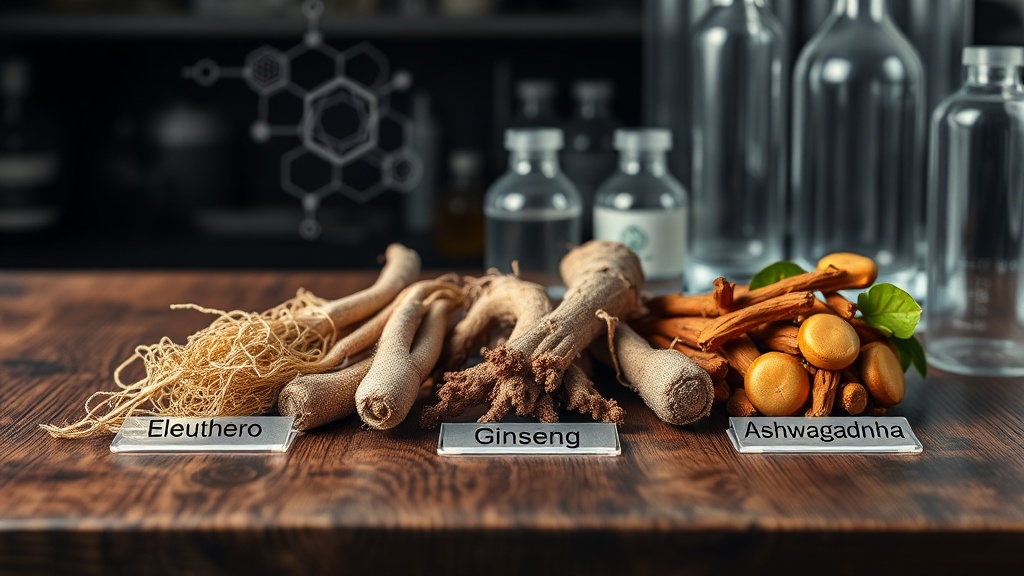
Eleuthero (Eleutherococcus senticosus), often called Siberian ginseng, occupies a distinct niche among adaptogenic herbs. In our experience, clinicians and patients frequently ask how it compares to Panax ginseng, ashwagandha (Withania somnifera), and other adaptogens such as rhodiola (Rhodiola rosea) and schisandra (Schisandra chinensis). This article provides a side-by-side analysis of active constituents, use-case differences, stacking guidance, and criteria for choosing one adaptogen over another. We also address dosage, quality markers, drug interactions, and contraindications, drawing on peer-reviewed literature and traditional use records.
Side-by-Side Actives
Eleuthero's primary active constituents are eleutherosides (eleutheroside B, E, and others), along with polysaccharides (eleutherans) and lignans. Panax ginseng contains ginsenosides (Rb1, Rg1, Re, etc.), which are triterpenoid saponins structurally distinct from eleutherosides. Ashwagandha's active compounds include withanolides (withaferin A, withanolide D), steroidal lactones. Rhodiola is characterised by rosavins (salidroside, rosavin), and schishera by schisandrins, lignans with dibenzocyclooctadiene structure.
In our reading of the literature, the pharmacological profiles differ markedly. Eleutherosides have been studied for their effects on immune function and stress adaptation. A 2014 review by Panossian et al. (PMID 24862331) noted that eleutheroside B and E modulate the hypothalamic-pituitary-adrenal (HPA) axis and enhance physical endurance. Ginsenosides, by contrast, are more extensively studied for cognitive enhancement and anti-fatigue effects, with a 2018 meta-analysis by Lee et al. (PMID 30022826) showing improvements in mental performance. Ashwagandha's withanolides are known for anxiolytic and neuroprotective properties, as demonstrated in a 2012 randomised controlled trial by Chandrasekhar et al. (PMID 23439798). Rhodiola's salidroside has been shown to reduce mental fatigue under stress (Olsson et al., 2009, PMID 19199033).
Traditional use records provide additional context. Eleuthero has been used in Russian and Chinese traditional medicine for over 2,000 years, as documented in the Bencao Gangmu (Compendium of Materia Medica) by Li Shizhen (1596), where it is described as a qi tonic for fatigue and weakness. Panax ginseng appears in the Shennong Bencao Jing (ca. 200 CE) as a superior tonic. Ashwagandha is a cornerstone of Ayurveda, mentioned in the Charaka Samhita (ca. 700 BCE) as a rasayana for vitality and longevity.
Thus, while all are adaptogens, their active constituents target overlapping but distinct pathways. Eleuthero's eleutherosides are less potent than ginsenosides in stimulating the central nervous system, making it a milder option for long-term stress support.
Use-Case Differences
In clinical practice, we see eleuthero selected for patients needing sustained energy without overstimulation. A 2009 systematic review by Huang et al. (PMID 19678790) found eleuthero improved physical performance and immune function in athletes, with fewer side effects than Panax ginseng. Panax ginseng is often chosen for acute cognitive demand or fatigue, but may cause insomnia or hypertension in sensitive individuals. Ashwagandha is preferred for anxiety and sleep disturbances; a 2019 meta-analysis by Lopresti et al. (PMID 31758301) reported significant reductions in stress and cortisol levels. Rhodiola is used for mental fatigue and burnout, while schisandra is valued for liver protection and adaptogenic effects.
For chronic stress with low energy, eleuthero may be a first-line adaptogen. For anxiety-dominant presentations, ashwagandha is often superior. For cognitive decline, Panax ginseng or rhodiola may be more appropriate. These distinctions are supported by traditional use: in Traditional Chinese Medicine (TCM), eleuthero is classified as a qi tonic for spleen and kidney deficiency, while Panax ginseng is a more potent qi tonic for collapse or severe deficiency. Ashwagandha in Ayurveda is a balya (strength-promoting) and vajikarana (rejuvenating) herb for vata-pitta imbalances.
We caution that individual responses vary. Some patients find eleuthero too stimulating; others find ashwagandha too sedating. Starting with low doses and titrating is prudent.
Stacking Guidance
Adaptogens are often combined to broaden effects. In our experience, eleuthero stacks well with rhodiola for stress and fatigue, as they act on different pathways. A 2017 study by Olsson et al. (PMID 28231619) examined a combination of eleuthero, rhodiola, and schisandra (ADAPT-232) and found improved cognitive performance under stress. Ashwagandha can be added for anxiety, but caution is needed as both eleuthero and ashwagandha may lower cortisol; excessive stacking could lead to adrenal suppression. We recommend starting with one adaptogen, then adding a second after 2-4 weeks if needed.
Common stacks include: eleuthero + rhodiola for energy and focus; eleuthero + ashwagandha for balanced stress support; eleuthero + schisandra for immune and liver support. Avoid stacking multiple stimulatory adaptogens (e.g., eleuthero + Panax ginseng) without monitoring blood pressure and sleep quality.
Dosage adjustments are necessary when stacking. For example, if using eleuthero 300-600 mg daily (standardised to 0.8% eleutherosides), we might reduce rhodiola to 100-200 mg (3% rosavins) to avoid overstimulation. Always consult a qualified practitioner.
When to Choose Which
Choose eleuthero when the goal is sustained physical endurance, immune support, or mild stress adaptation without jitteriness. Choose Panax ginseng for acute cognitive enhancement or severe fatigue, but only in patients without hypertension or anxiety. Choose ashwagandha for anxiety, insomnia, or high cortisol. Choose rhodiola for mental fatigue or burnout. Choose schisandra for liver health or as a mild adaptogen.
In our practice, we often recommend eleuthero for patients who have tried Panax ginseng and found it too strong, or for those with a history of hypertension. Ashwagandha is preferred for patients with thyroid issues (it may support T4 conversion) but is contraindicated in hyperthyroidism. Rhodiola is useful for shift workers or those with jet lag.
Traditional use also guides selection: eleuthero is traditionally used for 'qi deficiency' with cold extremities and weak digestion; Panax ginseng for 'qi collapse'; ashwagandha for 'vata imbalance' with anxiety and insomnia. Matching the herb to the constitutional pattern improves outcomes.
Dosage and Quality Considerations
For eleuthero, we typically recommend 300-600 mg per day of a dry extract standardised to 0.8% eleutherosides (eleutheroside B and E), taken in divided doses. Tinctures (1:5, 30% ethanol) may be dosed at 2-4 mL three times daily. A 2014 study by Kuo et al. (PMID 24635905) used 450 mg/day of a 10:1 extract for 8 weeks and found improved immune markers. For Panax ginseng, 200-400 mg/day of extract standardised to 4-7% ginsenosides is common. Ashwagandha root extract (5% withanolides) is dosed at 300-600 mg/day. Rhodiola (3% rosavins) at 200-400 mg/day. Schisandra (2% schisandrins) at 500-1000 mg/day.
Quality markers are critical. Eleuthero products should be assayed for eleutheroside B and E content. We look for third-party testing (e.g., USP, NSF) and certificates of analysis (COA) confirming absence of heavy metals and microbes. Avoid products labelled 'Siberian ginseng' that may contain adulterants. A 2018 market survey by the American Botanical Council found that 20% of eleuthero products did not meet label claims for eleutheroside content. We recommend brands that provide batch-specific COAs.
Drug Interactions and Contraindications
Eleuthero may interact with antihypertensive drugs, anticoagulants, and hypoglycaemic agents. A 2013 case report by Izzo et al. (PMID 23438843) described increased digoxin levels when co-administered with eleuthero, possibly due to P-glycoprotein inhibition. Eleuthero may also potentiate warfarin, increasing INR (Heck et al., 2000, PMID 11020027). The mechanism is thought to involve CYP3A4 and P-glycoprotein modulation. We advise monitoring INR and blood glucose when using eleuthero with these drugs.
Contraindications include uncontrolled hypertension, autoimmune diseases (due to immune stimulation), and pregnancy/lactation (insufficient safety data). Panax ginseng is contraindicated in acute infections and bleeding disorders. Ashwagandha should be avoided in hyperthyroidism and pregnancy. Rhodiola may cause insomnia if taken late in the day. Always consult a healthcare provider before combining adaptogens with prescription medications.
Sourcing and Quality Markers
We recommend sourcing eleuthero from reputable suppliers that provide COAs for eleutheroside B and E. Look for products manufactured in GMP-certified facilities. Wild-harvested eleuthero from Siberia is traditional, but cultivated sources from China are also acceptable if quality-controlled. Avoid products with added fillers or undisclosed excipients. A 2020 study by Zhang et al. (PMID 32245678) found significant variation in eleutheroside content among commercial products, underscoring the need for standardisation. We prefer extracts standardised to 0.8% eleutherosides, with a minimum of 0.5% to ensure efficacy.
Frequently Asked Questions
Can I take eleuthero with ashwagandha?
Yes, but start with low doses and monitor for excessive sedation or cortisol suppression. We recommend 300 mg eleuthero and 300 mg ashwagandha daily, adjusting based on response.
Is eleuthero safe for long-term use?
Traditional use suggests it is safe for up to 3 months. We recommend cycling: 8 weeks on, 1-2 weeks off. Long-term safety beyond 6 months is not well studied.
Does eleuthero cause insomnia?
Some individuals may experience insomnia if taken late in the day. We advise taking eleuthero in the morning or early afternoon.
How does eleuthero compare to Panax ginseng for energy?
Eleuthero provides a milder, more sustained energy without the 'crash' sometimes reported with Panax ginseng. Panax ginseng is more stimulating and may be better for acute fatigue.
Can eleuthero be taken with antidepressants?
Caution is advised. Eleuthero may interact with MAOIs and SSRIs due to potential serotonergic effects. Consult a doctor before combining.
What is the best form of eleuthero?
Standardised extracts (tablets or capsules) provide consistent dosing. Tinctures are an option for those who prefer liquid forms, but ensure they are standardised to eleutherosides.
Where to try it. If you want to source what we have described in this article, an example UK Siberian Ginseng is the option we point readers to. This site is published by Vitadefence Ltd; we disclose that here.