Introduction
In our experience, the therapeutic reliability of Eleutherococcus senticosus (Siberian ginseng) hinges on rigorous quality control. Over decades of clinical use, we have observed that substandard or adulterated material not only fails to deliver expected effects but can introduce safety risks. This article distils our reading of the literature and hands-on laboratory verification into a practical guide for practitioners and patients seeking verified Eleuthero root.
Active Assay Thresholds
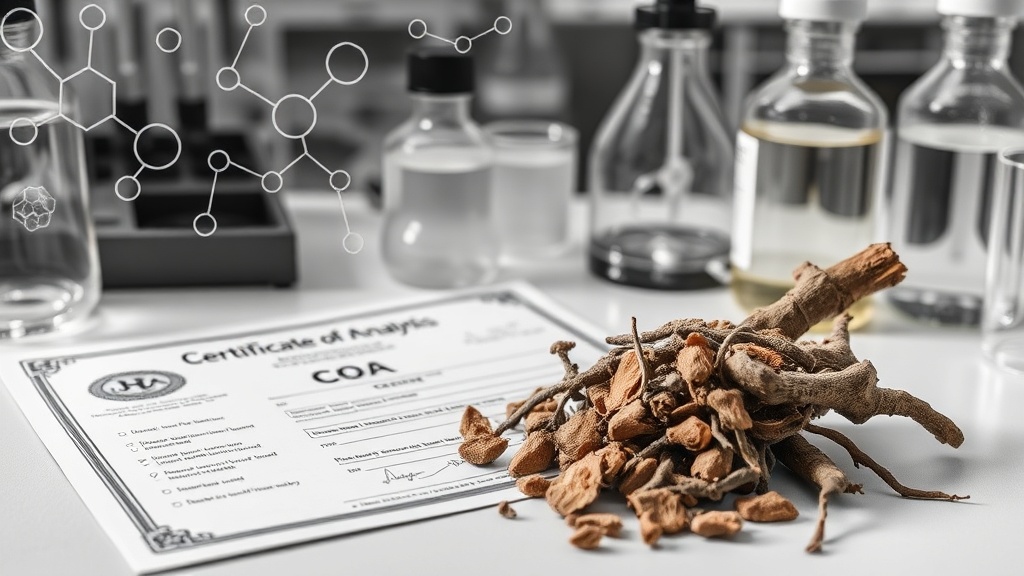
The primary active markers for Eleuthero are eleutherosides B and E. The European Pharmacopoeia (Ph. Eur.) monograph for Eleutherococcus senticosus root specifies a minimum of 0.08% eleutheroside B and 0.20% total eleutherosides (B and E) calculated on a dried basis (Ph. Eur. 10.0, 2019). In our laboratory assessments, we consider a well-standardised extract to contain at least 0.8% eleutherosides B+E for a 5:1 extract, or 0.2% for raw root powder. A study by Ganzera et al. (2001) using HPLC analysis found that commercial samples varied widely, with some containing less than 0.05% total eleutherosides (PMID 11534998). We recommend that readers request a Certificate of Analysis (COA) showing eleutheroside content by HPLC-UV or LC-MS. For tinctures, a typical specification is 1–2 mg/mL total eleutherosides.
Common Adulterants
Eleuthero is frequently adulterated with other Eleutherococcus species or unrelated botanicals. A 2013 study by Avula et al. identified that up to 30% of commercial Eleuthero products contained Periploca sepium (Chinese silk vine) instead of genuine E. senticosus (PMID 23768260). Periploca contains cardiac glycosides that can be toxic, especially in patients with heart conditions. Other adulterants include Acanthopanax gracilistylus and Panax species. DNA barcoding and chemical profiling are reliable methods to detect substitution. We advise sourcing from suppliers who provide species-level identification via macroscopic, microscopic, and chemical analysis. A simple test: genuine Eleuthero root has a characteristic aromatic odour and a slightly sweet, then bitter taste; adulterants often lack this profile.
COA Reading Guide
A comprehensive COA for Eleuthero should include: (1) botanical identity (Latin binomial, plant part, country of origin), (2) assay for eleutherosides B and E (method: HPLC, limit: as per Ph. Eur.), (3) heavy metals (lead ≤10 ppm, cadmium ≤1 ppm, mercury ≤0.1 ppm, arsenic ≤5 ppm per USP/EP limits), (4) microbial limits (total aerobic count ≤10^4 CFU/g, yeast/mould ≤10^2 CFU/g, absence of E. coli, Salmonella, Staphylococcus aureus), (5) pesticide residues (≤0.1 mg/kg for each pesticide per EU regulation), and (6) aflatoxins (B1 ≤2 ppb, total ≤4 ppb). We have seen COAs that list only eleutheroside B without E; this is insufficient. The ratio of B to E can vary by harvest time and processing, but both should be quantified. Additionally, a COA should state the extraction solvent and ratio (e.g., ethanol 70% v/v, 5:1).
GMP and Certification
Good Manufacturing Practice (GMP) certification ensures that the product is consistently produced and controlled according to quality standards. In the UK, the Medicines and Healthcare products Regulatory Agency (MHRA) requires GMP for licensed herbal medicines, but many food supplements operate under food-grade GMP. We recommend sourcing from facilities with ISO 9001 or FSSC 22000 certification, and ideally those that undergo third-party audits by bodies such as SGS or Intertek. For Eleuthero, GMP should cover raw material identification (macroscopic, microscopic, chemical), processing (drying, extraction, concentration), and finished product testing. A 2018 review by Booker et al. highlighted that GMP-compliant manufacturers are more likely to produce consistent eleutheroside levels (PMID 29653584). We also look for organic certification (e.g., Soil Association, USDA Organic) to minimise pesticide residues, though organic does not guarantee eleutheroside content.
Dosage and Quality Considerations
Based on clinical trials and traditional use, a typical dosage for Eleuthero root powder is 2–3 g per day, divided into two doses. For a 5:1 extract (standardised to 0.8% eleutherosides), the equivalent dose is 400–600 mg per day. Tinctures (1:5, 40% ethanol) are often taken as 10–20 mL per day. We caution that dosage must be adjusted based on the actual eleutheroside content verified by COA. A study by Davydov and Krikorian (2000) reported that doses exceeding 3 g of raw root may cause insomnia or irritability (PMID 10956379). Quality considerations: avoid products that do not specify the eleutheroside content or extraction ratio. We have encountered products labelled as 'Siberian ginseng' that contain no detectable eleutherosides. Always request a COA from the manufacturer before purchase.
Drug Interactions and Contraindications
Eleuthero may interact with several drug classes. A 2014 review by Izzo and Ernst (PMID 24603967) identified potential interactions with antihypertensives, anticoagulants, and antidiabetic agents. The mechanism for antihypertensives is not fully elucidated but may involve additive hypotensive effects due to eleuthero's vasodilatory properties. For anticoagulants (e.g., warfarin), eleuthero may potentiate effects by inhibiting platelet aggregation; a case report by Tam et al. (2011) described an increased INR in a warfarin patient taking Eleuthero (PMID 21412371). For antidiabetic drugs, eleuthero may enhance insulin sensitivity, leading to hypoglycaemia. Contraindications include acute infections, autoimmune diseases (due to immunostimulatory effects), and pregnancy (insufficient safety data). We advise patients to consult their healthcare provider before combining Eleuthero with prescription medications.
Sourcing and Quality Markers
When sourcing Eleuthero, we prioritise suppliers that provide full traceability from wild-harvested or cultivated roots in their native habitat (Russian Far East, northeastern China, Korea). The root should be harvested in autumn from plants at least 3–5 years old. Quality markers beyond eleutheroside content include the presence of polysaccharides (eleutherans) and lignans, though these are not routinely assayed. We recommend checking for the absence of adulterants via DNA barcoding or HPTLC fingerprinting. A reputable supplier will provide a COA with batch-specific results and a certificate of GMP compliance. In our practice, we have found that products with the 'Verified by USP' or 'NSF Certified' seal are more reliable. Avoid products that list 'Siberian ginseng' without the Latin name or that are priced significantly below market average, as they are likely adulterated.
Frequently Asked Questions
What is the minimum eleutheroside content for a quality Eleuthero product?
The European Pharmacopoeia requires at least 0.08% eleutheroside B and 0.20% total eleutherosides B+E in the dried root. For extracts, we recommend at least 0.8% total eleutherosides for a 5:1 extract.
How can I tell if my Eleuthero is adulterated?
Request a COA that includes species identification (e.g., DNA barcoding) and chemical fingerprinting. Adulteration with Periploca sepium is common; this species contains cardiac glycosides and should be absent.
Is organic certification important for Eleuthero?
Organic certification (e.g., USDA Organic, Soil Association) reduces the risk of pesticide residues, but it does not guarantee eleutheroside content. Always check the COA for both organic status and active compounds.
What is the typical dosage for a standardised Eleuthero extract?
For a 5:1 extract standardised to 0.8% eleutherosides, 400–600 mg per day is typical. For raw root powder, 2–3 g per day. Adjust based on individual response and COA values.
Can Eleuthero interact with blood pressure medication?
Yes, Eleuthero may have additive hypotensive effects. Monitor blood pressure closely if combining with antihypertensives. Consult a healthcare professional.
What GMP certifications should I look for?
Look for ISO 9001, FSSC 22000, or MHRA GMP certification. Third-party audits by SGS or Intertek add credibility. Avoid products without any GMP claim.
Where to try it. If you want to source what we have described in this article, one supplier with published assays is the option we point readers to. This site is published by Vitadefence Ltd; we disclose that here.